
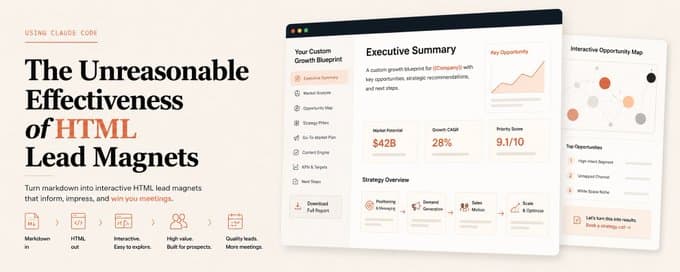
Most outbound teams are still sending PDFs. Some are sending Google Docs. A few have upgraded to Notion pages. All of them are leaving conversion on the table — and most of them don't know it.
There's a different way to build GTM assets that the best operators are just starting to figure out. It changes what you send prospects, how clients experience your proposals, and how quickly you can manufacture value before a sales call even happens.
It's HTML.
Not a website. Not a product. A single file — a self-contained interactive page — generated by an AI agent in minutes, distributed in a cold email, opened in any browser, and experienced like something a top-tier firm spent days building.
Here's why we've started building GTM assets this way — and why every cold email agency, GTM engineer, and growth team should be doing the same.
Why PDF Is the Wrong Format for GTM
The Old Playbook
- →Research a topic
- →Write it into a Word doc
- →Export as PDF
- →Attach to an email or gate it
- →Hope someone reads it
The New Playbook
- →Research using Claude Code + web
- →Build knowledge layer in Markdown
- →Render as interactive HTML
- →Distribute via URL or direct file
- →Prospect experiences your expertise
The old playbook worked in 2018. It doesn't work now. Not because the information is worse — but because the format is a signal.
"A PDF says: we put in effort before we knew you existed. Nobody believes it. And nobody reads past page three."
The pre-demonstration model — where you create custom value for a prospect before the sales call — is gaining ground fast. But most teams are executing it wrong. They're doing custom PDFs for everyone, or worse, generic templates with a name swapped in.
The format that actually makes pre-demonstration work isn't a PDF. It's an HTML file.
What HTML Does That PDF Can't
A single HTML file can carry eight types of information that PDF cannot:
Tables
Real, structured, interactive data. Filterable, sortable, searchable.
Design
Actual CSS. Brand colors, typography, spacing — not what a Word export preserves.
Illustrations
Inline SVG diagrams, flow charts, process maps that render at any resolution.
Code
Syntax-highlighted snippets that read like documentation, not a screenshot.
Interaction
Sliders, toggles, tabs, filters. JavaScript that makes the document respond.
Workflows
Boxes and arrows that communicate process — rendered as visuals, not ASCII.
Spatial Layouts
Positioning, density, hierarchy. Control over how information lands on the page.
Images
Embedded figures, screenshots, charts. Everything in one file.
Most importantly: everything stays in one file. One URL. One attachment. Opens in any browser on any device. No login. No software. No "can you send that as a PDF instead."
The Six GTM Use Cases
01 — Lead Magnets That Demonstrate Instead of Claiming
The standard cold email lead magnet is a generic guide. The new version is an interactive wiki that looks and feels like it was custom-built for the prospect's industry.
Real Example
PE Acquisition Guide — built for a cold email agency targeting $1M–$5M EBITDA service business owners
- →Filterable database of 100+ active PE buyers, searchable by type, geography, and sector
- →EBITDA multiple chart with live 2025 market data
- →20-item interactive exit readiness checklist with progress tracking
- →Copy-ready outreach templates for PE firms, family offices, and search funds
- →Red flags audit — deal killers vs. re-trade triggers, color-coded
- →Built-in sales page for the agency's own services with sticky CTA throughout
The whole thing — from research to published asset — took one session with Claude Code running on top of InfraSuite-delivered inboxes.
The agency sends this cold to business owners with $1M–$5M EBITDA. The prospect opens it, spends 15 minutes navigating real buyer data, completes their readiness checklist, and reads about the agency's offer at the bottom of every page.
"This is not a PDF with their name on it. This is a proprietary research resource that prospects will bookmark."
02 — Custom Proposals That Prospects Actually Read
Traditional proposals: 12-page PDF with three package tiers, a process overview, and a timeline. Formatted to look exactly like every other agency proposal the prospect has seen.
HTML proposals: a tabbed, navigable document scoped specifically to the prospect's business. Their industry. Their metrics. Their language. Interactive pricing where they can toggle options. A visual workflow showing exactly what happens week by week. An FAQ that addresses their specific objections before they're voiced.
We now build custom HTML proposals for high-value client conversations instead of sending PDFs. When a prospect responds to a cold email, they get a page that references their specific situation — not a template with their name swapped in. The difference in deal velocity is not subtle.
03 — Pre-Demonstration Deliverables for Positive Replies
This is where the economics of outbound change completely.
Old model: send 10,000 emails claiming you can do something. Ask for a meeting to explain how.
New model: send 10,000 emails offering a custom deliverable. When someone replies positively, generate the deliverable in minutes and send it before the call.
With HTML, the deliverable isn't a paragraph in an email. It's a full interactive document — a custom audit, competitive analysis, market research report, or scoring rubric — built specifically for their business using their website, their LinkedIn, their industry data. Claude reads the context. Claude builds the HTML. You send the link.
The prospect shows up to the call having already experienced what you do. The first meeting is a second meeting. The dynamic is fundamentally different.
04 — Client-Facing Sales Pages That Convert
For agencies and advisory firms selling B2B services, HTML pages serve as a higher-converting alternative to the static one-pager.
Instead of a capability deck via email attachment: build an interactive HTML page scoped to what the prospect cares about. Include their industry benchmarks, not generic stats. Let them navigate to the sections relevant to them. Embed your process, pricing context, and testimonials in a single navigable document. Add a "copy as brief" button that exports their configuration back to you.
This is a sales asset that works differently than a pitch deck. It's not linear. The prospect explores it at their own pace. It answers objections before the call. It makes you look like you're already doing the work.
05 — Client Onboarding Documents and SOPs
Once a deal closes, HTML becomes the delivery format for everything operationally complex. Campaign strategy documents. Targeting frameworks. ICP analysis. Deliverability SOPs. Week-by-week launch roadmaps.
A client who can access exactly the section they need, when they need it, has a fundamentally different experience than one scrolling through page 47 of a PDF.
06 — Internal GTM Research and Intelligence Briefs
Before every new campaign, new market entry, or new offer — there's a research phase. Competitive intel. ICP profiles. Buyer psychology. Market sizing. Outreach angle testing.
Claude Code can ingest your campaign data, CRM exports, call recordings, public market data, and competitor websites simultaneously — then produce a navigable HTML intelligence brief your team can actually use. Not a 200-line markdown doc that nobody reads past line 50.
How to Build These
- 1
Build the knowledge layer in Markdown
Research, notes, frameworks, databases — all in a markdown file. This is the LLM wiki layer. Structured, dense, processable. The quality of this layer determines the quality of everything that follows.
- 2
Prompt Claude Code to render it as HTML
Give it your design requirements — audience, tone, interactive elements, palette. Claude handles the CSS, JavaScript, layout, and interactivity.
Example prompt"Take this markdown file and render it as a premium HTML lead magnet for [target audience]. Include a filterable data table, interactive checklist, copy-ready templates with one-click copy buttons, and a contextual CTA at the bottom of every section. Use a light, institutional design palette." - 3
Distribute
Upload to S3, Cloudflare R2, GitHub Pages, or Netlify. Share the URL in cold email. Attach as a direct file. Gate it behind a form. One URL. Opens in any browser. No login required.
What This Looks Like Across Every Offer
| Offer | Lead Magnet HTML Asset | What It Does for GTM |
|---|---|---|
| Demand gen / outbound services | Industry-specific buyer database + outreach framework | Shows expertise before the meeting; filters for high-intent prospects |
| Revenue advisory | Custom EBITDA benchmark + peer comparison tool | Pre-demonstrates the diagnostic capability |
| Capital advisory | Lender criteria database + deal matching framework | Shows network depth without a call |
| Cold email infrastructure | Deliverability audit tool + benchmark comparison | Interactive proof of technical capability |
| GTM engineering | Custom ICP analysis + signal-based targeting framework | Demonstrates data intelligence before engagement |
| Sales consulting | Discovery call scorecard + conversion benchmark | Visualizes the gap between current and potential performance |
"The meeting that follows isn't a pitch. It's a second meeting."
None of This Works Without Clean Infrastructure
Here's the part most people skip: a beautifully built HTML lead magnet that never reaches the inbox is worth nothing.
The reason we can talk about pre-demonstration outbound at scale is because the infrastructure problem is solved. 98.5% deliverability. Enterprise Outlook and Google mailboxes tuned specifically for cold email. Set up inside your sending tool within 24 hours.
The assets get the meetings. The infrastructure gets the assets delivered.
Where This Is Going
Lead magnets are shifting from static documents to interactive intelligence tools.
The agencies that win over the next 24 months won't just have better copy in their cold emails. They'll have better pre-demonstration systems — assets that create genuine value before a prospect ever books a call.
HTML is what makes that economically viable. With Claude Code, one person can build assets that would have taken a design team and a developer a week — in a single session, scoped specifically to a target market, distributed at scale.
The format is not the point. The value delivered before the meeting is the point.
HTML is just the highest-fidelity way to deliver it.
Need cold email volume?
Get Bronze or Higher — We'll Build Your First HTML Lead Magnet Free
Every team on a Bronze package or higher gets a custom HTML lead magnet built specifically for their offer, their target market, and their GTM strategy. We research it, build it, and hand it to you ready to distribute.
- 98.5% deliverability — Outlook to Outlook and Outlook to Google tuned for cold email
- 24-hour fulfillment — All mailboxes in your sending tool within 24 hours
- All ESPs supported — Instantly, Smartlead, Apollo — set up exactly how you need
- Free HTML lead magnet — Custom-built for your offer on Bronze package or higher
- White-glove support — Customer-focused support from industry experts
- No promo codes needed — Lead magnet included automatically with qualifying packages